.webp?width=200&height=114&name=2x-Packleader-logo-large%20(1).webp "2x-Packleader-logo-large (1)")


Demand rarely slows down to wait for a production line to catch up. For mid-sized food and beverage manufacturers, the pressure usually shows up in the same place: packaging. The product can be made faster than it can be filled, capped, and moved to the next station.
That gap is where growth stalls. A retailer approves a new placement, a distributor expands coverage, or a seasonal spike hits, and suddenly the line that worked fine at lower volumes becomes the bottleneck. Manual and semi-automatic filling and capping setups that were adequate a year ago start showing their limits: inconsistent fills, slow changeovers, and operators working extended shifts just to keep pace.
Integrated filling and capping systems solve a specific version of this problem. Instead of running fill and cap as two separate steps with a manual handoff between them, these systems combine both operations into a single, coordinated unit. For plants trying to increase output without adding headcount or rebuilding an entire line, understanding how these systems differ matters more than chasing the highest headline speed on a spec sheet.
This guide compares the main types of integrated filling and capping systems available to mid-sized plants, with a focus on changeover speed, automation fit, and reduced manual handling.
Why Packaging Becomes the Bottleneck First
Production lines rarely fail all at once. They strain in one place first, and for most mid-market food and beverage producers, that place is packaging.
A few operational realities drive this:
- Line throughput is capped by the slowest station. If filling and capping happen as separate manual steps, the transfer between them introduces delay, even when both individual tasks are fast.
- Changeover time eats into productive hours. Producers running multiple SKUs, container sizes, or private label formats lose real production time every time the line has to be reconfigured.
- Labor dependency creates fragility. Manual filling and capping requires trained operators on every shift. When staffing is tight, output becomes unpredictable.
- Quality checks get rushed under pressure. As volume increases, operators under time pressure are more likely to let inconsistent fills or improperly seated caps slip through.
These are consistent with the warning signs that a packaging line has become the real production bottleneck, rather than the manufacturing process itself. None of this means the current setup was a bad decision. Most producers start with manual or semi-automatic equipment because it matches early volume and keeps capital investment low. The issue is that packaging capacity does not scale linearly with demand. At some point, the operation needs equipment built for a different production reality than the one it started in.
What an Integrated Filling and Capping System Actually Is
An integrated filling and capping system combines the filling station and the capping station into one coordinated unit rather than two separate machines connected by a conveyor and a person.
Instead of a container being filled, transferred by hand or by belt, and then capped as a distinct operation, the container moves through a single system that performs both functions in sequence, often on a shared indexing mechanism or turntable.
This matters operationally for three reasons:
- Fewer manual touchpoints. Every hand transfer between filling and capping is a point where speed is lost and inconsistency can enter the process.
- Tighter process control. Fill volume and cap torque or seating can be coordinated within the same system rather than managed independently.
- A smaller equipment footprint. Combining two functions into one system often requires less floor space than two standalone machines plus the conveyor and staging area between them.
For a closer look at what integration changes on the floor, see 7 Things to Know About Integrated Filling and Capping.
Types of Integrated Filling and Capping Systems
Mid-sized plants generally choose between four general categories of integrated systems. Each fits a different combination of volume, SKU variety, and labor strategy.
Semi-Automatic Integrated Units
These systems combine filling and capping into one frame, but still require an operator to load containers, initiate cycles, or handle some portion of the process manually.
Best fit: Producers moving beyond fully manual production but not yet ready for full automation, often due to lower run volumes or a wide mix of container types.
Strengths: Lower capital investment, smaller footprint, and a shorter learning curve for operators.
Tradeoff: Throughput is still limited by operator pace, and the equipment does less to reduce labor dependency than fully automatic options. This is often the same limitation covered in Is Manual Bottle Labeling Slowing Your Production?, where manual steps elsewhere on the line create a similar ceiling.
Rotary Monobloc Systems
Rotary systems mount filling and capping heads around a rotating turntable. Containers enter, move through fill and cap stations as the turntable indexes, and exit ready for labeling or casing.
Best fit: Higher-volume production with a manageable number of container formats.
Strengths: High throughput, continuous motion reduces cycle time, and the mechanical design supports precise, repeatable fill and cap operations.
Tradeoff: Changeovers between significantly different container sizes or shapes can take longer to set up than on a linear inline system, and the equipment represents a larger capital investment. Top speed alone does not guarantee better output, a point explored further in Faster Machines Don't Always Increase Packaging Line Throughput.
Inline Automatic Systems
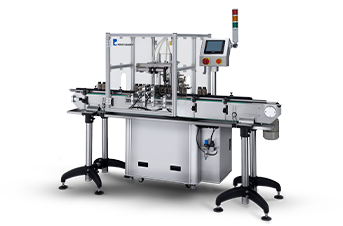
Inline systems move containers in a straight line through separate but connected fill and cap stations, coordinated by a shared control system.
Best fit: Plants running a moderate to high volume with frequent format changeovers across multiple SKUs.
Strengths: Generally faster and simpler changeovers than rotary systems, a modular layout that can accommodate additional stations later, and straightforward integration with upstream and downstream equipment.
Tradeoff: At very high volumes, inline systems may not match the raw throughput ceiling of a rotary monobloc design. Changeover time is worth scrutinizing closely here, since changeovers in automatic equipment often cost more than expected when tooling and setup are not accounted for upfront.
Modular Integrated Systems
Modular systems are built so that filling and capping stations, along with supporting equipment such as labeling, can be added or reconfigured as production needs change.
Best fit: Producers who expect continued growth but want to avoid a full line replacement every time volume increases.
Strengths: Equipment expands with the operation instead of requiring a new system purchase, and production capacity can be added incrementally.
Tradeoff: Initial configuration requires clear planning around future SKU and volume expectations to avoid under-building the system. Producers running a wide product mix should also watch for the signs a line is struggling to keep up with too many SKUs, since that pressure tends to surface before overall volume does.
Comparing the Options
| System Type | Changeover Speed | Automation Fit | Manual Handling | Best Volume Range |
|---|---|---|---|---|
| Semi-Automatic Integrated | Moderate | Entry-level automation | Some manual loading and cycling required | Lower to moderate |
| Rotary Monobloc | Slower for major format changes | High-volume, continuous production | Minimal once loaded | Moderate to high |
| Inline Automatic | Fast, especially with quick-change tooling | Strong fit for multi-SKU production | Low | Moderate to high |
| Modular Integrated | Depends on configuration | Scales with added stations | Low, decreasing as automation expands | Moderate, built to grow |
Operational Considerations Beyond Speed
Choosing a system based on top speed alone is one of the more common mistakes manufacturers make with packaging automation. A few operational factors deserve equal weight.
Changeover frequency matters more than changeover speed in isolation. A plant running one or two SKUs benefits most from raw throughput. A plant running eight or more SKUs benefits more from equipment built for fast, repeatable changeovers, even if peak speed is slightly lower.
Integration with existing equipment reduces risk. A new filling and capping system does not operate in isolation. It needs to work with upstream conveying, downstream labeling, and existing container handling. Systems designed to integrate into current lines reduce the disruption of installation and lower the chance that the new equipment becomes its own bottleneck.
Operator training and dependency should factor into the decision. Equipment that requires constant adjustment or specialized troubleshooting knowledge creates a different kind of labor dependency, one tied to a smaller pool of trained operators rather than general labor availability.
Service and parts availability affects real-world uptime. A system with strong on-paper specifications is only as reliable as the support behind it. Producers should evaluate how quickly issues can be resolved, not just how the equipment performs when everything is working correctly.
Common Questions About Integrated Filling and Capping Systems
Before requesting quotes or scheduling demonstrations, it helps to work through 9 questions worth asking before buying filling and capping systems. The questions below cover a few that come up most often during evaluation.
How much floor space does an integrated system typically require compared to separate filling and capping equipment? Combining functions into one system generally reduces footprint compared to running standalone filling equipment, a conveyor section, and a separate capping equipment, since the transfer and staging space between them is eliminated. Exact dimensions vary by system type and container size, so floor plan review during evaluation is worthwhile.
Can an integrated system handle multiple container sizes and shapes? Most systems can, though the ease of switching between formats varies by type. Inline systems with quick-change tooling tend to offer faster format switching, while rotary systems may require more setup time for significant size changes.
Do integrated systems reduce the need for skilled labor, or just the number of workers? Both, to different degrees. Fully automatic inline and rotary systems reduce headcount on the line, while also shifting the skill requirement from manual dexterity to equipment operation and basic troubleshooting.
Is a modular system a good option if we are not sure how much we will grow? Modular systems are specifically designed for that uncertainty. They allow capacity to be added as demand becomes clearer, rather than requiring a full commitment to a fixed throughput level up front.
Deciding When It Is Time to Evaluate a Change
A few signals tend to indicate that current filling and capping equipment has reached its limit:
- Changeovers are consuming a growing share of each shift
- Fill or cap consistency issues are increasing as speed demands rise
- Orders are being delayed because packaging cannot keep pace with production
- Operators are working extended hours specifically to manage manual filling or capping steps
- New retail or distribution commitments require volume the current line was not built to support
If two or more of these are present, it is a reasonable point to start evaluating integrated options rather than continuing to patch the existing setup.
Choosing the System That Fits Your Line, Not Just Your Volume Target
The right integrated filling and capping system is not always the fastest one on paper. It is the one that matches how the plant actually runs: how many SKUs move through it, how often formats change, how much manual handling the team can realistically sustain, and how the equipment will fit into the line that already exists.
For most mid-sized plants scaling production, the goal is not maximum speed in isolation. It is predictable output that holds up shift after shift, without introducing new points of failure. Reviewing changeover frequency, SKU variety, and growth expectations before comparing equipment specifications will lead to a stronger, more durable decision than starting with a speed number alone.




.webp?width=360&name=2x-color-logo%20(1).webp "2x-color-logo (1)")