.webp?width=200&height=114&name=2x-Packleader-logo-large%20(1).webp "2x-Packleader-logo-large (1)")

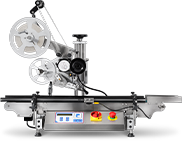
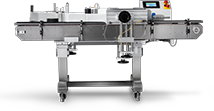
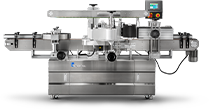
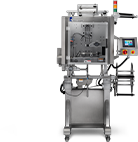

Quick answer: For food and beverage production lines, the best "label printer" is rarely a standalone printer at all. Once you are labeling more than a few hundred units per shift, the equipment that actually determines label quality, changeover speed, and line uptime is a label applicator or print and apply labeling system that pairs a thermal print engine with automated placement. Standalone desktop label printers work for short-run, back-of-house tasks like secondary labeling or date coding, but they are not built to keep a packaging line moving at production volume.
This distinction matters more than most buyers realize, and it is the reason a generic search for "best label printer" can send growing food and beverage producers toward the wrong category of equipment entirely.
Why This Question Gets Answered Incorrectly
Search results for "best label printer for food packaging" are dominated by desktop and semi-desktop printer brands built for retail, craft, and small-batch use. These printers solve a real problem for kitchens, delis, and home-based food businesses that need to print a barcode or ingredient label on demand.
That is a different problem than the one facing a growing food and beverage manufacturer.
If your production line is filling, capping, or packing more than a few hundred containers per shift, the operational question is not "which printer prints the clearest label." It is "how do we apply consistent labels to every container, at line speed, without adding labor or slowing down changeovers." This is close to what most manufacturers get wrong about packaging automation in general: the equipment spec sheet matters less than how it performs inside the full production environment.
That question points to label application equipment, not desktop printing, and it often surfaces alongside a related pattern: too many SKUs quietly making the packaging line inefficient.
Label Printer vs. Label Applicator: What Is the Real Difference
Label printer: Produces a printed label. A desktop or industrial print engine creates the barcode, lot code, ingredient panel, or brand graphic on demand, using thermal transfer or direct thermal printing.
Label applicator: Places a label onto a container accurately and consistently, container after container, without manual handling.
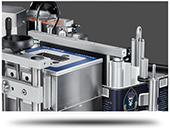
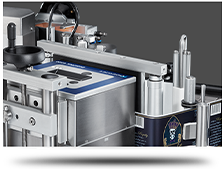
Print and apply labeling system: Combines both functions into one piece of equipment. A print engine generates the label, and an integrated applicator places it on the container in the same motion, on the line.
For low-volume needs, a printer alone may be enough. For production environments, the printer is only half of the equation. Label placement, not label printing, is usually where food and beverage lines lose time and consistency.
Thermal Transfer vs. Direct Thermal Print Engines
Most industrial print and apply systems use one of two printing methods:
| Print Method | How It Works | Best For |
|---|---|---|
| Thermal transfer | Uses a ribbon to transfer ink onto the label material | Labels exposed to moisture, refrigeration, freezer storage, or long shelf life |
| Direct thermal | Heat-sensitive label stock darkens without ribbon or ink | Short shelf-life labeling, date coding, and applications where labels do not need to survive extended cold or wet exposure |
For most food and beverage packaging, especially products stored in coolers, freezers, or condensation-heavy environments, thermal transfer printing holds up better over time. Direct thermal is a reasonable fit for labels with a short usable life, such as same-day date codes.
Types of Label Application Equipment for Food Packaging
Food and beverage producers typically evaluate labeling equipment across three categories, depending on production volume and line maturity. Finding the perfect automatic labeling machine for food products usually starts with placing your line honestly into one of these categories rather than shopping by price or brand name first.
Semi-Automatic Label Applicators
Capability An operator loads or positions each container, and the equipment applies the label with consistent placement and pressure.
Operational Explanation The system removes the manual labeling motion while still requiring an operator to handle container placement.
Production Outcome Producers moving off fully manual labeling gain consistency and speed without committing to a fully automated line.
Best fit: growing producers who have outgrown hand labeling but are not yet running high-speed, fully automated lines. Producers evaluating their first upgrade should pay attention to what low-cost automatic labeling options don't show you before committing to a specific machine.
Inline Automatic Label Applicators
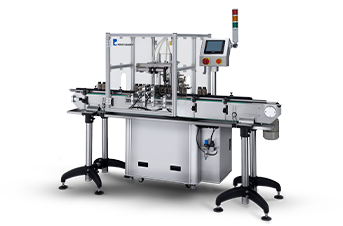
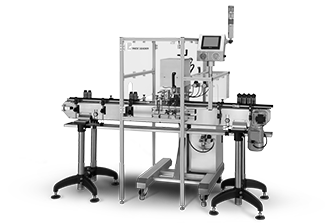
Capability Containers move through the applicator on a conveyor, and labels are applied automatically without an operator touching each unit.
Operational Explanation The applicator synchronizes with line speed to place labels at a consistent point on every container.
Production Outcome Labor is reduced, label placement stays consistent across long shifts, and the line can run at higher, steadier throughput.
Best fit: established production lines where labeling has become the bottleneck relative to filling and capping.
Modular Print and Apply Systems
Capability An integrated print engine and applicator that generates and places variable data labels, such as lot numbers, expiration dates, or barcodes, directly on the line.
Operational Explanation Because printing and application happen together, variable information can be updated without changing pre-printed label stock.
Production Outcome Producers running multiple SKUs, private label runs, or frequent formula and packaging changes can adjust label content without reprinting inventory or slowing the line for a changeover.
Best fit: producers managing SKU proliferation, private label contracts, or frequent regulatory labeling updates. This is typically the equipment category behind efforts to streamline a packaging line with advanced labeling machines rather than adding headcount to keep pace with SKU growth.
Comparison at a Glance
| System Type | Operator Involvement | Typical Use Case | Changeover Effort |
|---|---|---|---|
| Semi-automatic label applicator | Moderate | Growing lines moving off hand labeling | Low to moderate |
| Inline automatic label applicator | Minimal | Established lines needing consistent high-volume output | Moderate |
| Modular print and apply system | Minimal | Multi-SKU production, variable data, private label | Moderate, with flexible label content |
None of these categories is universally "best." The right fit depends on current volume, SKU variety, and how much manual labeling is already slowing the line.
Operational Considerations Beyond the Equipment Itself
A label applicator or print and apply system does not operate in isolation. A few operational realities determine how well it performs once it is running production.
- Container variation. Bottles, tubs, pouches, and cartons all require different label placement mechanics. Equipment should be evaluated against your actual container shapes and sizes, not a generic spec sheet.
- Label accuracy and compliance. Ingredient panels, allergen statements, and lot codes carry regulatory weight. Inconsistent placement or smudged printing creates compliance and recall risk, not just a cosmetic issue.
- Line integration. Labeling equipment needs to run at the same pace as your filling and capping systems. A labeler that outpaces or lags behind the rest of the line becomes a new bottleneck instead of solving the old one, and it is worth remembering that faster machines don't always increase packaging line throughput if the rest of the line cannot keep up.
- Changeover time. As SKU count grows, the ability to switch label formats, sizes, or content quickly becomes as important as raw application speed. Changeovers in automatic labeling can cost more than producers expect if this is not evaluated up front.
Frequently Asked Questions
What is the difference between a label printer and a label applicator? A label printer produces the printed label. A label applicator places that label onto a container. Production lines typically need both functions working together, either as separate equipment or combined in a print and apply system.
Do I need a full print and apply system, or just a label applicator? If your label content changes frequently, such as variable lot codes, expiration dates, or multiple SKUs, a print and apply system is usually the better fit. If your labels are pre-printed and consistent, a standalone applicator may be sufficient.
What label printing technology holds up best in cold or wet food environments? Thermal transfer printing generally performs better than direct thermal printing in refrigerated, frozen, or condensation-prone environments, since it resists fading and smudging over time.
Can label applicators integrate with existing filling and capping equipment? Yes. Most food and beverage producers add labeling equipment to an existing line rather than replacing the entire packaging setup. Integration should be evaluated against your current line speed and container handling, not treated as a standalone purchase.
How fast can an industrial label applicator run? Speed varies by equipment type and container format. Inline automatic applicators and print and apply systems are generally built to match or exceed filling and capping speeds, so labeling does not become the limiting step on the line.
Signs It Is Time to Evaluate Labeling Equipment
A few operational patterns typically signal that current labeling methods have become a constraint rather than a solution:
- Labeling is the slowest step on an otherwise automated or semi-automated line
- Label placement is inconsistent from container to container
- SKU growth is creating frequent manual changeovers
- Staff are dedicated primarily to hand labeling during peak production
- Retail or distributor partners are flagging label quality or placement issues
Any one of these on its own may not justify a change. Several appearing together usually means labeling has quietly become the production bottleneck, a pattern closely tied to why low-cost labeling machines start to limit production as you scale and, more broadly, why a packaging line can't keep up with rising demand.
Matching Labeling Equipment to Where Your Line Actually Is
The right answer to "what is the best label printer for food packaging" depends less on printer specs and more on how your production line is actually running today. A producer hand labeling a few hundred units a day has different needs than one running multiple SKUs across a semi-automated line at retail volume.
Before evaluating specific equipment, it helps to look at container types, current line speed, SKU count, and how much labeling still depends on manual labor. That operational picture points toward the right category of equipment, whether that is a semi-automatic applicator, an inline automatic system, or a modular print and apply setup built for variable data.
Pack Leader USA works with food and beverage producers to evaluate labeling equipment in the context of the full packaging line, not as an isolated purchase. If labeling has become the constraint on your production floor, that is the conversation worth having next.




.webp?width=360&name=2x-color-logo%20(1).webp "2x-color-logo (1)")