.webp?width=200&height=114&name=2x-Packleader-logo-large%20(1).webp "2x-Packleader-logo-large (1)")


Manufacturers are under constant pressure to produce faster, safer, and with greater consistency. Automation has become a critical part of staying competitive because it helps companies reduce labor costs, minimize errors, and maintain quality across high-volume production runs.
Even in some semi-automated packaging lines, one overlooked issue continues to slow everything down: manual container handling. While fillers, sealers, and labelers may be automated, manually loading trays, food packaging containers, or lids creates a bottleneck that disrupts flow and limits overall efficiency. This pulls operators away from higher-value tasks to manage repetitive placement, and the entire line suffers as a result.
This is where a pick and place machine, also known as a denester machine, can be a strategic addition to your line. It’s compact in size, but it plays a critical role in eliminating one of the most common bottlenecks in semi-automated packaging lines. By automating container or tray separation and placement, denesters help maintain a smooth, continuous workflow that allows the rest of your equipment to perform at its full potential.
What Is a Pick and Place Machine and How Does It Work?
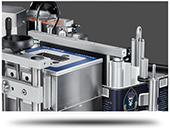
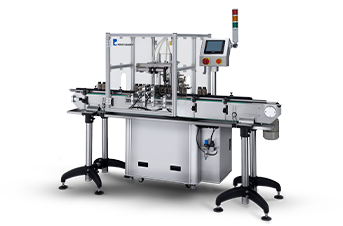
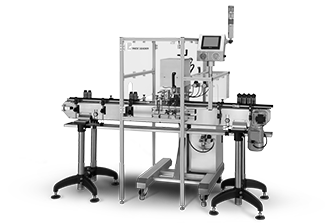
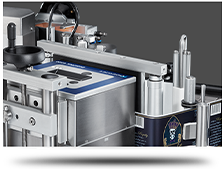
A pick and place machine is a piece of packaging equipment designed to automatically separate stacked trays, containers, or lids and place them precisely onto a conveyor or into the next stage of the packaging process. Rather than relying on operators to manually load each item, the denester handles this repetitive task consistently and efficiently.
A denester machine works by:
- Holding a stack of nested trays, containers, or lids
- Separating individual items using mechanical, vacuum, or pneumatic systems
- Placing each item accurately onto a moving conveyor
Denesters are mostly used for packaging materials like plastic trays, thermoformed containers, paperboard trays, aluminum pans, and certain types of lids. Their flexibility makes them valuable across a wide range of food, beverage, pharmaceutical, and consumer goods applications.
By automating the separation and placement process, pick and place machines eliminate one of the most labor-intensive steps in packaging. This saves time and ensures uniform spacing and alignment, which are critical for downstream processes like filling, sealing, and labeling.
How Denesters Integrate With Other Packaging Equipment
Denesters are most effective when they are integrated as part of a cohesive packaging system. Rather than functioning as a standalone system, they serve as a bridge between manual handling and automated processing.

Feeding Containers to Fillers
When connected upstream of a filling system, pick and place machines ensure that food packaging containers are delivered in a steady, controlled manner. This consistent feed rate allows fillers for liquid, solid, or particles to operate without interruption. This means your line will experience fewer stops, less product waste, and more reliable output.
Supporting Sealers and Lid Application
Precise container placement is essential for sealing and lid application. Denesters ensure trays or food packaging containers arrive properly aligned, reducing misfeeds that can lead to sealing errors or rejected packages. This consistency is especially important in high-speed operations where even small alignment issues can compound quickly.
Maintaining Flow for Accurate Labeling
Labelers depend on consistent product spacing and orientation to apply labels accurately. By delivering containers evenly and predictably, denesters help labelers maintain accuracy without slowing down the line. This improves label placement, reduces rework, and protects brand presentation on the shelf.
When integrated correctly, denesters help synchronize the entire line, minimizing downtime and creating a smoother, more reliable production flow. Denesters can be paired seamlessly with Pack Leader USA labeling systems and modular line configurations, making them an ideal addition to semi-automated packaging environments.
Why Pick and Place Machines Deliver More Than Just Automation
Adding a pick and place machine to your packaging line delivers numerous benefits. By removing one of the most repetitive and labor-intensive steps in the packaging process, denester machines help stabilize production flow and allow the rest of your equipment to operate more efficiently. This single improvement often creates a ripple effect across the entire line, improving consistency, reducing downtime, and increasing your capacity.
Improved Productivity
Manual container loading can lead to pauses, inconsistencies, and delays that reduce overall throughput. Denesters encourage continuous operation by keeping food packaging containers moving without interruption. This steady flow allows downstream equipment to run at optimal speeds, increasing output without adding shifts or labor.
Labor Efficiency
By automating repetitive tray or container handling, denesters free operators to focus on higher-value tasks like quality checks, equipment monitoring, or changeovers. This improves workforce efficiency while reducing the physical demands placed on employees.
Product Consistency
Inconsistent manual placement can lead to misfeeds, jams, and irregular spacing that affect filling, sealing, and labeling accuracy. Pick and place machines deliver uniform placement every time, improving consistency across the entire packaging process and reducing downstream errors.
Scalability
Denester machines also let you gradually increase automation. They allow manufacturers to move from manual handling to semi-automated workflows without committing to a fully automated line all at once. As production grows, denesters can be integrated with additional equipment to support higher speeds and greater automation.
Safety and Ergonomics
Repetitive lifting and placement tasks increase the risk of operator fatigue and strain injuries. Automating these steps with a denester improves workplace safety and helps create a more ergonomic production environment.
Key Factors to Evaluate Before Adding a Pick and Place Machine
Before integrating a pick and place machine, it’s important to evaluate how it will fit within your existing packaging setup.

Compatibility With Existing Equipment
Ensure the denester aligns mechanically and operationally with your conveyors, fillers, sealers, and labelers. Proper synchronization is crucial to maintain a smooth product flow and prevent bottlenecks elsewhere on the line.
Adjustability and Maintenance
Look for denester machines that offer easy adjustments for different tray or container sizes. Tool-less changeovers and simple maintenance access reduce downtime and make it easier to adapt to new products or packaging formats.
Space and Speed Requirements
Denesters come in various footprints and speed capabilities. So, you must assess available floor space and determine the throughput needed to match your production goals. Proper planning ensures the pick and place machine enhances flow rather than creating congestion.
Modular Integration Support
Working with an equipment provider that offers modular, plug-and-play system options simplifies installation and future expansion. Modular systems allow denesters to be added without extensive line redesign, making automation more accessible and scalable.
Eliminate Manual Handling and Keep Your Line Moving
Denester machines may seem like a small addition to a packaging line, but their impact can be significant. By automating food packaging containers handling, denesters eliminate one of the most common bottlenecks in semi-automated packaging environments. In turn, you get smoother flow, reduced labor demands, improved consistency, and a packaging line that performs closer to its full potential.
If your operation still relies on manual container handling, it may be time to take a closer look at where automation can deliver the biggest return. Identifying and removing these manual steps often gives you efficiency gains across the entire line.
To learn more about building a more efficient, integrated packaging system, download our free Food Manufacturer’s Guide to Food & Beverage Labeling Equipment and explore how modular automation solutions can support your production goals.




.webp?width=360&name=2x-color-logo%20(1).webp "2x-color-logo (1)")