


This shows up most on lines that have scaled in pieces rather than all at once. Filling and capping got upgraded first, since that's typically where mid-sized plants start. Labeling gets added or adjusted later, often without revisiting how well it actually integrates with the conveyor running underneath it. The result is a line where every station has its own rated speed on paper, but the line as a whole runs at whatever speed the weakest integration allows. That gap is a large part of why a packaging line can't keep up with demand even when the equipment itself isn't at fault.
Inline labeling machines are built to close that gap, but only when the integration is done right. A labeling head with an impressive top speed rating can still become the constraint on a line if it doesn't synchronize cleanly with existing conveyor timing, which is one reason faster machines don't always increase packaging line throughput. The difference between equipment that fits a line and equipment that fights one usually shows up during changeovers, not during the sales conversation.
Why Labeling Becomes the Line's Weak Point
Most packaging lines grow in stages. A producer starts with manual or semi-automatic processes and adds automation as volume increases. That incremental approach makes sense financially, but it often leaves labeling as the last station to catch up, which is one of several signs a packaging line has become inefficient due to too many SKUs.
A few production realities tend to expose this gap:
- Line speed increases faster than the labeling process can keep pace with
- Container or label format changes require manual adjustment
- Labor availability limits how much manual labeling a shift can absorb
- Labeling accuracy affects retailer acceptance and compliance, so errors carry real cost
None of this means the rest of the line is poorly run. It means labeling has a narrower margin for error than most operators expect until it becomes the constraint. Many of these gaps trace back to what manufacturers get wrong about packaging automation when a station is automated in isolation rather than as part of the full line.
What an Inline Labeling Machine Actually Does
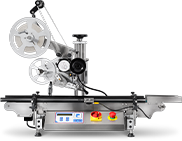
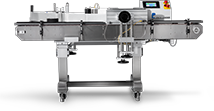
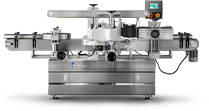
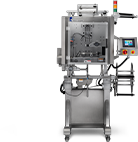
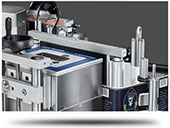
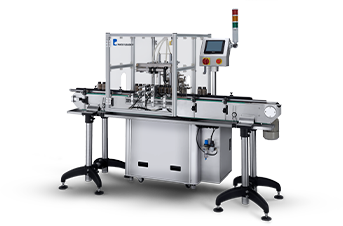
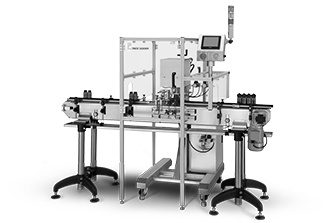
An inline labeling machine applies labels to containers as they move continuously along a conveyor, rather than requiring product to stop, be manually positioned, or be handled off-line. The equipment reads container position, applies the label at the correct point on the container, and returns the product to the line without interrupting flow.
At a functional level, inline labeling equipment typically involves:
- Conveyor synchronization, so the labeling head applies at the correct moment relative to container speed and spacing
- Container detection, using sensors to identify position and trigger application
- Label application, whether pressure-sensitive, wrap-around, or another format suited to the container
- Changeover adjustment, allowing the equipment to be reset for different container sizes or label formats without extensive downtime
The goal of inline labeling equipment is not simply to apply a label. It is to apply that label without becoming the reason the rest of the line has to slow down.
Operational Considerations for Conveyor Integration
Conveyor integration is where inline labeling equipment either earns its place on the line or becomes another piece of equipment operators have to work around. A few operational factors determine which outcome a producer gets.
Conveyor Speed and Line Synchronization
Inline labeling equipment has to match the actual speed of the conveyor it is integrating with, not a theoretical maximum. Equipment that is rated for high speed but does not synchronize cleanly with existing conveyor timing will create hesitation points, even if the labeling head itself is fast.
Container Variation
Producers running multiple SKUs need labeling equipment that can accommodate different container shapes, sizes, and label placements without a full mechanical rebuild. Setup time between runs matters as much as raw application speed, since changeovers happen far more often than most speed specifications account for. This is exactly why changeovers in automatic labeling often cost more than producers expect: the true cost sits in reconfiguration time, not top speed.
Floor Space and Line Layout
Conveyor integration is a physical constraint as much as a mechanical one. Equipment needs to fit the existing line footprint, including infeed and outfeed spacing, without forcing a redesign of the surrounding stations.
Operator Involvement
Equipment that requires constant operator attention to stay in sync with the conveyor defeats the purpose of automating the station in the first place. Reliable integration means the labeling process runs with minimal intervention once it is set, with operators monitoring rather than manually correcting.
Reliability Under Continuous Operation
A labeling station that jams or misapplies labels under continuous run conditions creates downtime elsewhere on the line, since product often cannot bypass the station. Reliability at the labeling stage protects the throughput of every station around it.
Comparing Inline Labeling Approaches
Not all inline labeling equipment is built for the same production environment. Understanding the tradeoffs helps producers evaluate what fits their actual line, rather than the fastest number on a spec sheet.
Semi-automatic inline labeling tends to suit lower volume lines or producers who are transitioning off a low-cost or manual labeling setup, but it still requires more operator involvement than a fully automated system. Fully automatic inline labeling fits high-throughput lines with consistent container formats well, though it demands more upfront setup and integration planning. Producers who expect to scale volume or add stations over time are usually better served by modular inline labeling systems, since a modular design allows the line to expand without a full equipment replacement.
Label application method matters just as much as automation level. Contact application generally works well on rigid containers with stable, flat, or cylindrical surfaces, while non-contact application is often the better fit for irregular container shapes or products that are sensitive to handling, provided the conveyor synchronization is precise enough to support it. Producers working specifically with food products and the container variation that comes with them tend to weigh this tradeoff more heavily than producers running a single, stable container format.
The right choice depends less on which approach is more advanced and more on which approach matches the container types, volume, and labor model already in place on the line. Producers who have already begun to streamline their packaging line with advanced labeling equipment usually made that call based on their own changeover and volume patterns rather than a single spec comparison.
Common Questions About Inline Labeling and Conveyor Integration
What makes an inline labeling machine different from a standalone labeling station?
An inline labeling machine is built to operate as part of a continuous conveyor line, applying labels while product remains in motion. A standalone station typically requires product to be removed from the line or staged separately, which reintroduces manual handling that inline equipment is meant to eliminate.
Can inline labeling equipment integrate with an existing conveyor without replacing the line?
In most cases, yes. Inline labeling equipment is generally designed to integrate into existing conveyor infrastructure, provided the line has adequate spacing and speed compatibility. Integration planning should confirm conveyor speed, container dimensions, and available footprint before installation.
How much does changeover time matter for high-throughput lines?
Changeover time directly affects effective throughput, even on equipment rated for high speed. A machine that runs quickly but takes considerable time to reconfigure between SKUs may produce less usable output over a shift than one with a lower top speed and faster changeover.
What signals indicate a line needs to move from manual to inline labeling?
Common signals include labeling becoming the visible bottleneck behind faster upstream stations, inconsistent label placement caused by manual application, and labor constraints limiting how much labeling volume a shift can handle without added headcount.
Signals Your Labeling Station Has Become the Constraint
Production teams do not need a full breakdown to justify evaluating inline labeling equipment. Watch for these patterns instead:
- Labeling consistently limits how fast the rest of the line can run
- Changeovers between SKUs are taking longer than the labeling task itself should require
- Manual labeling is creating accuracy issues that affect retailer or compliance requirements
- Production volume is expected to grow beyond what current labor availability can support manually
If more than one of these applies, the labeling station is likely already shaping how much the rest of the line can produce, whether or not it has been identified as the formal bottleneck.
Making the Integration Work, Not Just the Machine
Inline labeling equipment is not a single decision made in isolation. It has to work with the conveyor speed already running, the container variation already in production, and the labor model already in place. Equipment that integrates cleanly reduces manual handling and supports throughput. Equipment that does not becomes another station operators have to manage around.
Pack Leader USA builds inline labeling equipment intended to integrate with existing conveyor systems, support modular expansion as production scales, and reduce the manual intervention required to keep a line running consistently. For teams evaluating where labeling fits into a broader packaging upgrade, the most useful starting point is a conversation about current conveyor speed, container variation, and where labeling sits relative to the rest of the line today.



